
NYSE: TEN / Get Stock Price
 

Years of experience


Tenneco History

See Where We're From and Become Part of Where We're Headed...

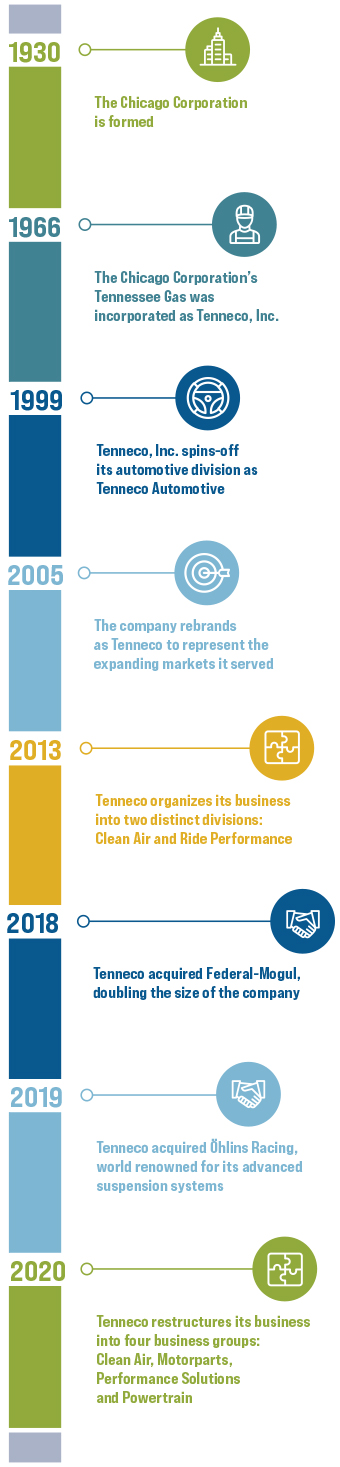
  • Tenneco Inc. emerged from a conglomerate consisting of six unrelated businesses (shipbuilding, packaging, farm and construction equipment, gas transmission, automotive, and chemicals).
  • All businesses except automotive and packaging were disposed of between 1994 and 1996 (through public offerings, sales, spin-offs and mergers).
  • Tenneco Packaging spun-off to shareholders in November 1999 following refinancing of Tenneco Inc.'s debt.
  • Changed name to Tenneco Inc. in October 2005; trading on the NYSE as TEN.

Back to top


Our Journey...

1888
Economy Spring Company (a predecessor of Walker Manufacturing), a manufacturer of farm wagon springs was founded.
 
1926
Brisk Blast Manufacturing Company's name was changed to Monroe Auto Equipment Company, which introduced its first shock absorber.
 
1963
Monroe expanded to Europe; established Sint Truiden, Belgium manufacturing facility.
 
1965
Walker expanded to Europe; opened Belfast, Northern Ireland, facility.
 
1967
Walker became a part of Tenneco through Tenneco's acquisition of Kern County Land Company.
 
1977
Tenneco acquired Monroe; formed Tenneco Automotive with Walker and Monroe as its two operating divisions.
 
1985
Acquired Monroe Australia.
 
1987
Acquired Walker Australia.
 
1990
Acquired Rancho Industries, a supplier of off-road sport suspension components.
 
1994
Acquired the Gillet Group, making Walker the largest exhaust manufacturer in Europe.
 
1995
Established Hydraulics, a joint venture in India to produce ride control and exhaust products.

Launched a Chinese joint venture, Beijing-Monroe Shock Absorber.

Acquired Fonos, Spain's largest replacement exhaust producer.
 
1996
Acquired Clevite, a manufacturer of vibration control components.

Expanded operations in South America by acquiring Minuzzi Argentina's second largest exhaust manufacturer.

Acquired Fric-Rot, Argentina's largest ride control producer.
 
2008
Acquired the suspension business of Gruppo Marzocchi, an Italian-based worldwide leader in supplying suspension technology and products in the two-wheeler market.
 

Back to top


Day One

On Nov. 5, 1999, a group of executives stood at the podium of the New York Stock Exchange to ceremoniously ring the opening bell. To the sounds of applause and cheering, the first day of trading for the new corporation kicked-off and the new Tenneco was born.

The previous day marked the formal end of the old Tenneco conglomerate - a vestige of the corporate era of combining diverse businesses into a single, sprawling entity. In the case of Tenneco, that meant activities as diverse as shipbuilding, natural gas pipelines, farm machinery and chemicals. Over the years, the conglomerate had trimmed operations until two distinctively different businesses remained: packaging and automotive parts manufacturing. The final step in the conglomerate devolution was the spin-off of Tenneco Packaging (renamed Pactiv Corporation) leaving Tenneco Automotive as a new, stand-alone company.

Tenneco Automotive, in one sense, was a new company with a number of the senior executives fresh to the organization. Looking at its business components, however, reveals a long, rich history. Its earliest business, the predecessor to the Walker emission control business, began in 1888 and the Monroe ride control segment traces back to 1926. In November 1999 these venerable businesses took on new life as Tenneco Automotive began to function as a standalone company.

The past 10 years have been marked by changes, challenges and opportunities. But there have also been constants: an emphasis on putting the customer first, investing in technology, establishing a global manufacturing and engineering footprint second to none, and a process culture driven by execution and continuous improvement.

The challenges began immediately as the new Tenneco Automotive inherited the long-term debt of $1.7 billion associated with the spin-off. The urgent need to service that debt prompted an intense focus on generating cash through working capital improvements, tight controls on discretionary spending and instituting programs to improve manufacturing and distribution efficiency.

Back to top


Operational Excellence

From its beginning, Tenneco has employed the Business Operating System as its core management process for operating. In addition, the company has embraced Lean manufacturing to reduce costs, trim inventories, improve customer lead times and ensure on-time product delivery. The company has also made Six Sigma a standard approach for improving product quality, reducing waste and driving product uniformity. The process has been extended back to the design stage to build these qualities into products from their inception. Most recently, Tenneco instituted the Tenneco Manufacturing System (TMS) throughout the organization, which was inspired by many of the key principles of the Toyota Production System and has since continued to raise the bar for Tenneco's Process Excellence performance.

The systems and processes have served Tenneco as it has faced a number of obstacles from the beginning. From the need to service a large debt burden at its inception as a stand-alone company, Tenneco has met the challenges of major worldwide economic downturns, changes in the automotive marketplace, fierce competition, and volatile changes in raw material prices. In the face of difficulties, Tenneco has maintained an optimistic attitude and a positive belief that it has the resources and ingenuity to overcome whatever hurdles it encounters and to ultimately prosper - an attitude summarized in the slogan adopted in 2002: Our Mission is Go! Of course, a slogan cannot replace decisive, timely action.

The new company conducted a thorough review of its operations in light of rising costs and declining product demand. As a result, it launched Project Genesis in December 2001, which resulted in the closing of eight plants worldwide and streamlining of operations in 21 other facilities. That same year, Tenneco organized a global supply chain management organization to leverage its purchasing power, making greater use of supplies from lower-cost sources, and developing alternative materials. These and other actions produced quick results as Tenneco achieved its first year of operating profitability in 2002.

Tenneco's main focus throughout its ten years has been on growth. Its strategy, maintained despite changes in the operating environment, has centered on developing technology that meets customer needs, penetrating emerging markets, and expanding into adjacent markets beyond the automotive industry.

Back to top


Pioneering Advanced Technologies

On the emission control side of the business, Tenneco's technological achievements include solutions that help customers meet new emission control regulations around the world, as well as other emissions innovations like the diesel particulate filter (DPF), selective catalytic reduction (SCR), Semi-Active Muffler (SAM) valves and fabricated manifolds. Tenneco's ride control technologies include breakthrough products such as the Continuously Controlled Electronic Suspension System (CES) for OE manufacturers and the ReflexTM shock absorber and Quick Strut for the aftermarket. The elastomer technology portfolio has grown as well, with recent innovations like the hydroelastic body mount, designed to achieve better vehicle ride solutions.

Tenneco's technological leadership has earned four prestigious wins and several honorable mentions for the Automotive News PACE Awards, which recognize superior innovation by automotive suppliers. The award-winning technologies include diesel aftertreatment predictive development process, the ASD shock absorber, the Kinetic RFS system, and the low-cost, light-weight muffler.

Back to top


Growing Globally

Geographically, Tenneco has grown its global footprint. The company was an early participant in the booming China automotive market, beginning in 1995, and by 1999, established three joint venture (JV) operations - emission control JVs in Dalian and Shanghai, and a ride control JV in Beijing. Today, the company operates six majority-owned joint ventures and one wholly-owned plant, and Tenneco is the No.1 OE emission control supplier in China. Joint ventures like these have provided access to new countries and new customers. In 2000, Tenneco formed a strategic alliance with Futaba Industrial Co., followed in 2001 by a similar agreement with Tokico Ltd., both top-tier Japanese suppliers to the country's leading automotive manufacturers.

In 2001, another JV opened the door to sales of emission control products in Thailand. In Europe, the company aligned with its customers' movement eastward to lower-cost countries, establishing manufacturing facilities in Poland, Russia and the Czech Republic by 2003.

Back to top


Market Expansion

The third segment of Tenneco's growth strategy recognized the need to expand beyond its traditional automotive market of passenger cars and light trucks. In pursuit of adjacent markets, the company developed ride control and emission control products for commercial vehicles (on-road trucks and off-road equipment, including construction, agricultural and forestry applications) and specialty vehicles, including motorcycles. Tenneco has also begun developing diesel aftertreatment products for locomotives. In 2005, Tenneco acquired the company supplying emission control products for Harley-Davidson motorcycles. Expanding its position in the two-wheeler vehicle market in 2008, Tenneco acquired the suspension business of Gruppo Marzocchi, an Italian-based worldwide leader in supplying suspension technology and products.

To better reflect the company's expansion into products for a wider variety of vehicles, Tenneco Automotive changed its name in 2005 to Tenneco Inc.

Back to top


Meeting Changes and Overcoming Challenges

A number of changes among Tenneco's executive ranks have not disrupted the company's long-term strategic focus. The most significant of these internal changes was the departure of the stand-alone company's first chairman, president and chief executive officer, Mark Frissora, in 2006. Gregg Sherrill joined the company as the new Chairman and Chief Executive Officer. After joining Tenneco, he affirmed the company's direction: "Tenneco has achieved industry leadership by successfully executing on proven strategies for generating growth, entering new markets and improving the company's operational performance. I am eager to continue this tradition and build on our successes globally." Under Sherrill's leadership, the company has implemented a five-year strategic vision process, which has resulted in a strengthening of the company's advance-technology position; an accelerated push into the commercial vehicle market; and an expanded presence in growth markets like China, India and Thailand.

Externally, global economic crisis that struck in September 2008 severely disrupted financial and credit markets with crushing impact on the automotive industry. Tenneco responded with aggressive cost management and cash generation programs to match its worldwide workforce and manufacturing network to market demands.

Back to top


Looking Ahead

By the close of the third quarter in October 2009, Tenneco had successfully turned the corner with the worst of the economic downturn behind it. A large part of Tenneco's improved performance was due to the entire Tenneco team's relentless focus on cash and doing more with less, which continues to pull the company forward and engender an employee culture of continuous improvement. While too soon to declare a victory, as the industry still faces a multitude of challenges, this competitive advantage is enabling Tenneco to begin the road to recovery and capture future growth prospects.

In just 10 short years, Tenneco has emerged as strong standalone company and has positioned itself as a sound global automotive supplier. From Day One, Tenneco has had a disciplined focus, an employee culture of teamwork and execution, and a commitment to customer service - all characteristics of a great company. Given this, Tenneco faces the future with confidence in its financial success, growth opportunities and market leadership.

Back to top